
Many people commonly consume diet soda, believing it helps them lose weight and that it is a much safer option than other soda drinks.
Yet, we are here to inform you that unfortunately, it is detrimental to your health. According to a Purdue researcher, public health officials should warn people not to consume diet soda, just like they avoid regular, sugar-sweetened soda.
Susan E. Swithers, Ph.D., a professor of psychological sciences and a behavioral neuroscientist at Purdue, maintains that we should limit the intake of all sweeteners, including no-calorie sweeteners.
She reviewed recent studies which examined the effects of diet soda and found that 30 percent of American adults and 15 percent of American children consume artificial sweeteners, such as aspartame, sucralose, and saccharin. She says:
“There is a lot of pressure from the public health sector to find solutions to counter the rise of obesity and chronic disease, and there is a lot of money and business at stake for the food industry as it develops and promotes these products.
Beverages are becoming political issues as government leaders and politicians seek regulation and taxing to limit their availability and consumption, but most of these measures exclude diet soft drinks because they are perceived as healthy.
Apparently, artificial sweeteners confuse the body’s natural ability to manage calories based on tasting something sweet, and people consume sweet foods in excess, leading to a twice increased risk of metabolic syndrome.
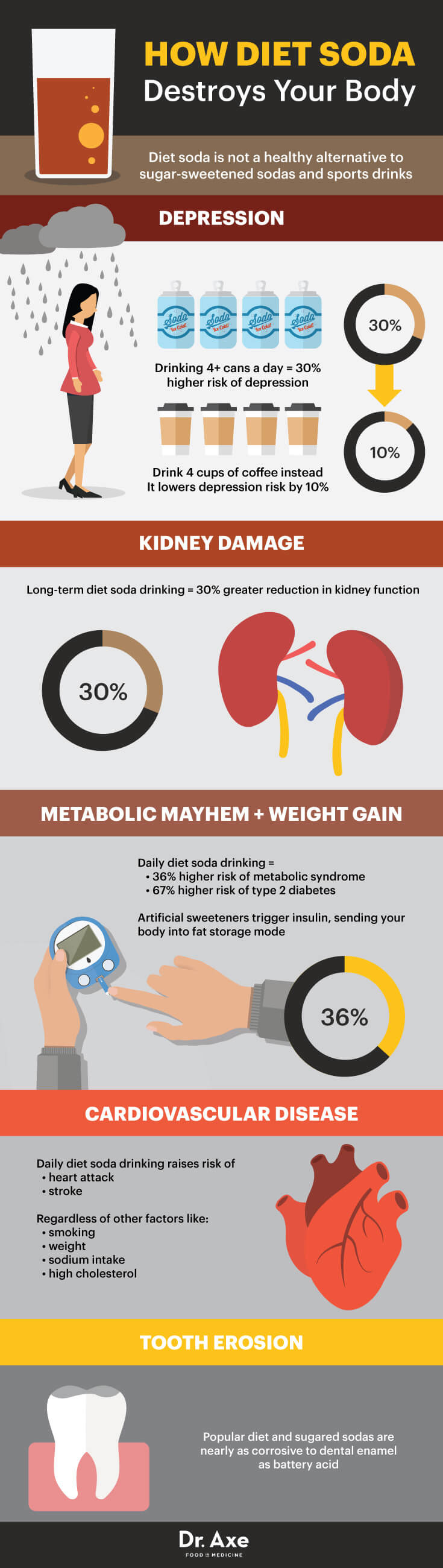
Research has found that diet soda leads to numerous health issues, including:
- Type 2 Diabetes & Metabolic Syndrome
The journal Diabetes Care published a 2009 study which showed that the consumption of diet soda is related to a 36 percent higher risk of metabolic syndrome and a 67 percent raised risk of type 2 diabetes.
Artificial sweeteners interfere with the gut-brain connection, leading to metabolic derangements. A team of experts at the Weizmann Institute of Science in Israel found that these drinks change the gut microbes by raising the risk of metabolic diseases.
They fed mice with zero-calorie sweeteners found in these drinks, such as saccharin, aspartame, and sucralose, and they developed glucose intolerance.
- Depression
The intake of more than 4 cans of soda a day is related to a 30 percent higher risk of depression, while the consumption of 4 cups of coffee provides protective effects and reduces the risk of depression by 10 percent.
- Compromised Lungs
These drinks raise the risk of developing asthma and COPD symptoms. According to one Australian study, 13.3 percent of surveyed participants with asthma and 15.6 percent of those with COPD consumed more than 2 cups of soda daily.
- Kidney Damage
Experts at Harvard examined people who consumed soda drinks for more than 20 years and showed that the long-term diet soda drinking leads to a 30 percent greater reduction in kidney function.
- Cardiovascular Disease
A study conducted at the University of Miami and Columbia University involved over 2,000 adults for 10 years and found that those who consumed these drinks had a higher risk of heart attacks and stroke, and had more chances to die due to heart diseases.
- A Less Protected Brain
Aspartame, which is a common artificial sweetener in these drinks, has been found to damage the brain’s antioxidant defense system, so its long-term intake causes an imbalance in the antioxidant/pro-oxidant status in the brain, mostly via t the mechanism containing the glutathione-dependent system.
Studies have also found that this sweetener is related to:
- Diabetes
- Brain tumors
- Migraines & headaches
- Fatigue
- Lymphoma
- Depression
- Chemical sensitivities
- Alzheimer’s disease
- Arthritis
- Weight gain
- Anxiety
- Chronic fatigue syndrome
- Hearing loss
- Epilepsy
- ADHD
- Parkinson’s
- Fibromyalgia
- Short term memory loss
- Multiple sclerosis
- Birth defects
Due to all this, you should be careful with the consumption of diet sodas, as they are far from a healthier alternative to regular sugar-sweetened soda. They actually lead to weight loss and cause various health issues, including heart diseases, metabolic damage, and obesity.
In case you enjoy fizzy drinks, we suggest a much healthier option: kombucha!
Source: draxe.comInfographic source: draxe.com
References:
besthealthyguide.comwww.healthylifebyte.com
References:
besthealthyguide.comwww.healthylifebyte.com